
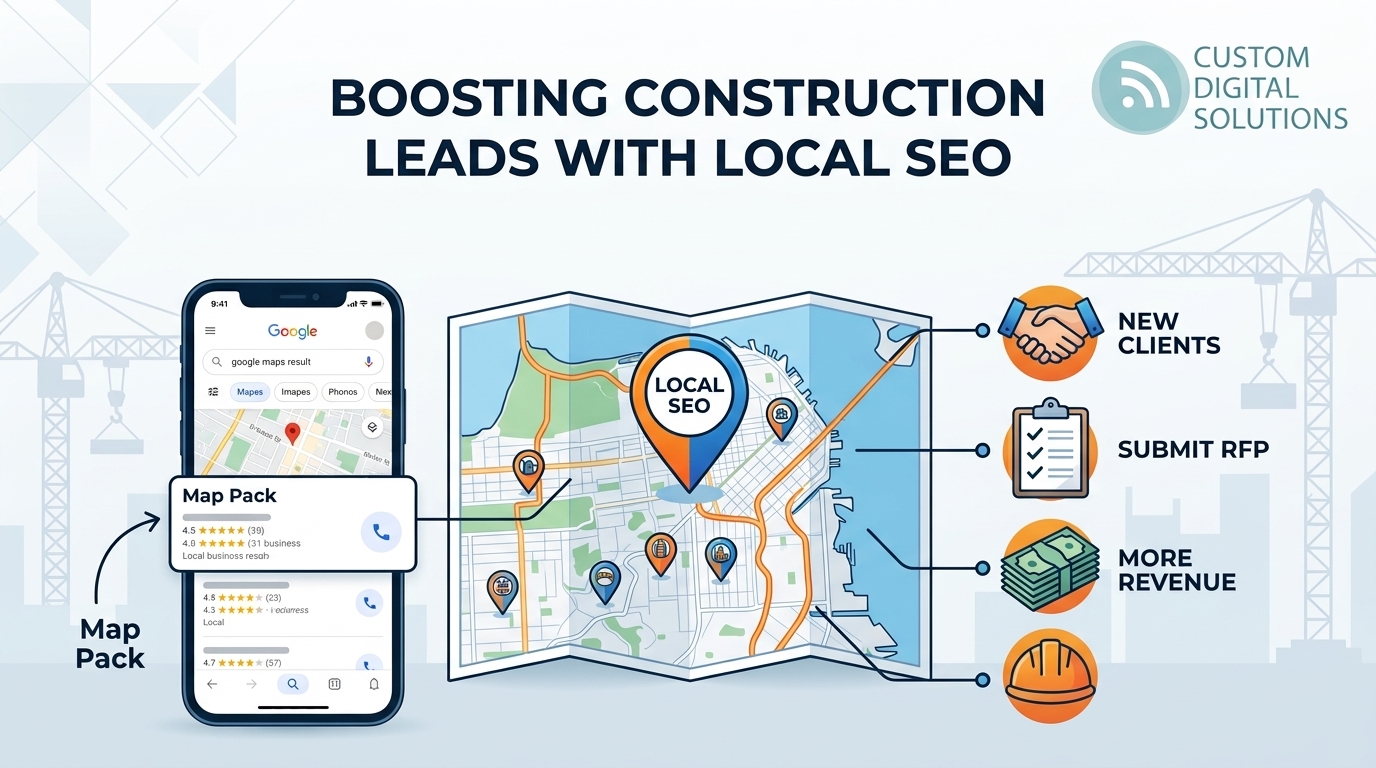
Local SEO helps construction companies capture qualified leads by optimizing their online presence for geo-targeted search queries. It positions contractors in Google’s Map Pack and top organic results when high-intent property owners, developers, and project managers search for local construction services, driving higher-value RFPs and phone calls.
The construction industry has permanently shifted to digital. Relying only on referrals, trade networks, and bid boards can leave contractors vulnerable to market changes and inconsistent revenue. Today, commercial property managers, developers, and homeowners often use search engines to find contractors. A strong local SEO strategy helps your construction firm rank in key service areas, attract qualified leads, and win more valuable projects.
The Economics of Local SEO for Construction
Local Search Engine Optimization (SEO) is not merely about generating web traffic; it is a direct channel for pipeline stability and business growth.
Why Word-of-Mouth Marketing Is Leaving Money on the Table
Word-of-mouth recommendations are valuable, but they lack predictability and scalability. When a developer or facility manager receives a verbal referral, their next step is almost always digital verification. They search for your firm’s name, evaluate your portfolio online, and read third-party reviews. If your local search visibility is weak, unverified, or buried beneath competitors, you lose credibility before the first conversation takes place.
High-Intent Search vs. Passive Social Ads
Social media campaigns push ads to users who may not require construction services for months or years. Conversely, local search captures users at the peak of buying intent.
When a user searches for “commercial general contractor in charleston” or “industrial warehouse builder near me,” they have a project, a budget, and an urgent requirement. Local SEO places your firm directly in front of prospective clients at the precise moment they are ready to issue an RFP.
The 5-Pillar Local SEO Execution Blueprint for Builders
To rank consistently in competitive construction markets, contractors require a structured, technically sound local search framework across Google Business Profile management, location page deployment, technical schema, citations, and review generation.
1. Google Business Profile (GBP) Dominance & Map Pack Ranking
A construction company optimizes its Google Business Profile by choosing precise primary and secondary categories, maintaining consistent NAP (Name, Address, Phone) details, defining exact service boundaries, and regularly uploading geo-tagged photos of completed jobsites to signal active local operations.
Google’s Map Pack (the top three local listings displayed with a map) commands over 44% of total clicks on local search queries. Securing a spot in this section requires rigorous profile optimization:
- Category Precision: Set your primary category to match your highest-margin core discipline (e.g., General Contractor, Commercial Real Estate Developer, Roofing Contractor). Add specific sub-categories like Building Firm, Masonry Contractor, or Remodeling Contractor.
- Service Area Definition: Delineate your operating radius by explicit zip codes or recognized metropolitan boundaries rather than setting blanket parameters.
- Geo-Tagged Visual Proof: Upload high-resolution images of active job sites, completed builds, heavy equipment, and uniformed crews on a weekly schedule. High image velocity signals real-world activity to Google’s ranking algorithms.
2. High-Converting Location & Service Area Pages (SAPs)
Targeting multi-city regions without physical brick-and-mortar offices in each location requires dedicated, high-value Location and Service Area Pages.
Avoid copying identical text across multiple city pages and changing only the city name. Search engines penalize duplicate programmatic content. Instead, build custom location hubs featuring:
- Real project case studies specific to that municipality.
- Map embeds showing recent job site coordinates.
- Local zoning code commentary, permit insights, or climate-specific construction considerations.
- Direct quotes and testimonials from clients located in that specific sub-market.
Ensuring these location hubs feature modern, responsive designs via specialized web development services maximizes both search rankings and user engagement.
3. On-Page Semantic SEO and Construction Schema Markup
Search engines rely on structured data to parse complex corporate entities and physical operating footprints. Implementing structured JSON-LD LocalBusiness and ConstructionBusiness schema directly into your code provides search engines with verified corporate details.
Support structured schema with structured headings (H2s and H3s) incorporating semantic, LSI keywords such as design-build protocols, pre-construction planning, site development, general contracting terms, and tenant upfits.
4. Local Citation Ecosystem & Industry-Specific Backlinks
Backlinks remain a primary search ranking factor. However, for contractors, local relevance outweighs general domain authority.
Focus link acquisition efforts on local and industry-specific authorities:
- Trade Associations: Associated General Contractors of America (AGC), Associated Builders and Contractors (ABC), and regional builder exchanges.
- Local Business Networks: Regional Chambers of Commerce, economic development boards, and commercial real estate groups.
- Supplier & Vendor Partners: Obtain links from material manufacturers, equipment suppliers, and architectural partners via featured case studies.
Maintain strict Name, Address, and Phone number (NAP) consistency across every business directory (Yelp, Houzz, BuildZoom, ThomasNet) to strengthen search engine trust signals.
5. Review Generation Systems and Reputation Management
Online reviews impact local SEO rankings by signaling operational trust, customer satisfaction, and active engagement to search algorithms. High star ratings and keyword-rich customer feedback directly improve Map Pack placement and increase user click-through rates.
Relying on informal, verbal requests for client reviews yields inconsistent results. Establish an automated post-project review workflow:
- Trigger an automated SMS or email request upon milestone completion or final sign-off.
- Direct the client to a simplified Google review page link.
- Prompt clients to mention the specific service provided and location in their review text e.g., “Apex completed our industrial warehouse renovation in Austin on schedule”.
- Respond promptly to every review using localized service terminology.
How to Convert Local Map Pack Traffic into High-Value RFPs
Ranking at the top of local search engines drives site visitors, but compelling design and clear messaging turn those visitors into qualified project leads.
Essential Conversion Triggers for Construction Websites
- Visible Contact Information: Display your office phone number, direct bid desk email, and main office address prominently in the top header.
- Interactive Project Portfolios: Organize case studies by project type, scale, square footage, completion timeframes, and specific geographic locations.
- Prominent Bidding CTAs: Feature high-contrast conversion buttons such as “Request a Bid,” “Submit an RFP,” or “Schedule Site Inspection” above the fold.
- Trust Badges & Safety Credentials: Highlight bonding capacity, OSHA compliance scores, licensing details, and industry awards near primary lead intake forms.
Measuring Local SEO Success: KPIs That Matter to General Contractors
Focusing on vanity metrics like overall impression volume offers limited insight into actual growth. Track performance indicators tied directly to sales pipelines:
- Geo-Grid Rankings: Measure your GBP’s rank performance across a multi-mile grid surrounding your target territory, rather than relying on a single zip code search.
- Inbound RFP & Bid Volume: Track phone calls and form submissions generated directly through organic search channels.
- Organic Search Pipeline Value: Calculate total monetary project value generated from organic and local map traffic.
Scale Your Construction Pipeline with Local SEO
Unpredictable bid boards and inconsistent referrals can limit long-term growth. High-value construction projects go to contractors who stay visible, build local authority, and appear prominently in search results when clients are ready to hire.
A focused local SEO strategy optimizing your Google Business Profile, creating localized content, implementing technical schema, and building industry citations. Creates a steady pipeline of high-intent leads.
Every month your business remains invisible in local search, competitors are winning the projects you could be securing. Ready to dominate local search and attract more high-value contracts? Partner with Custom Digital Solutions for a strategic consultation.
FAQs
How long does Local SEO take for construction companies?
Most construction companies see improvements in rankings, calls, and leads within 60–90 days. Stronger market visibility typically takes 6–12 months.
What is the most important local ranking factor for contractors?
A fully optimized Google Business Profile is one of the most important factors, along with proximity, reviews, and consistent business information.
How do location pages help contractors rank in other cities?
Location pages build relevance for secondary service areas through localized content, project examples, testimonials, and regional information.
Why are online reviews important for construction SEO?
Reviews build trust, improve local visibility, and increase conversions. Consistent, positive reviews can strengthen your local search presence.
Can commercial construction companies benefit from Local SEO?
Absolutely. Developers, architects, and facility managers often use localized searches to find commercial contractors and specialized construction firms.