
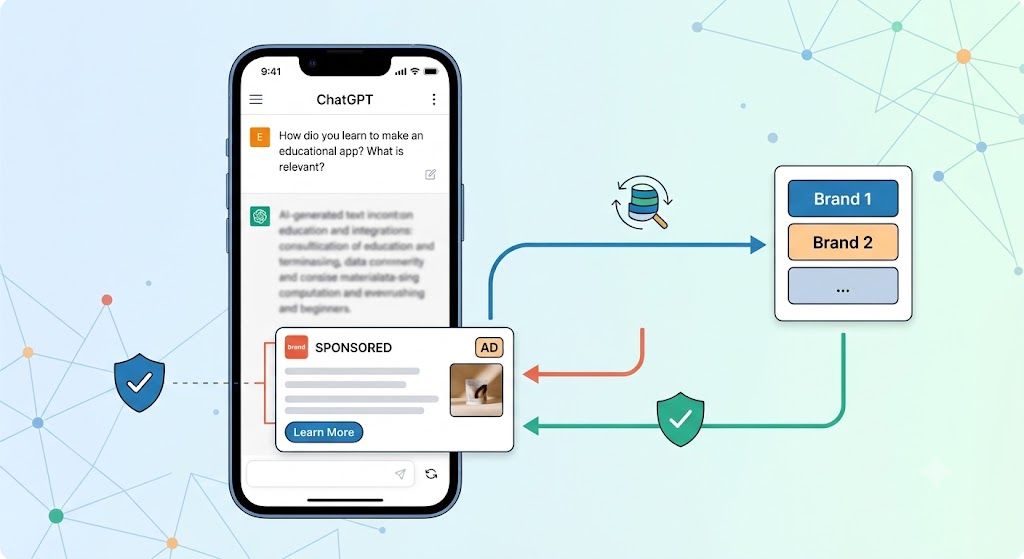
ChatGPT Ads are sponsored cards that appear below ChatGPT responses when a business, product, or service is relevant to the user’s conversation. OpenAI began testing this advertising format on February 9, 2026, initially in the United States, and by July 2026 expanded availability to Canada, the United Kingdom, Australia, New Zealand, Japan, and South Korea. Ads are shown only to users on the Free and Go plans, while Plus, Pro, Business, Enterprise, and Education subscribers receive an ad-free experience. Advertisements are matched to the context of the conversation rather than the user’s identity, and advertisers do not have access to users’ chats.
How Do ChatGPT Ads Work?
ChatGPT ads work through contextual targeting. When someone sends a prompt, OpenAI’s system reads the topic of the conversation, runs a brand safety check, finds ads whose headline, copy, and landing page fit that topic, and uses a relevance model to pick the single best match, which then appears below the answer.
Here is the whole process in five steps:
- A person asks a question. Someone types a prompt, for example “best running shoes for flat feet under $150”.
- The system reads the context. OpenAI’s ad system looks at what the conversation is about. Not who the person is. What they are trying to figure out.
- A brand safety check runs. Sensitive topics like health, mental health, and politics are filtered out. No ads appear near them.
- Relevant ads are matched. The system finds ads whose topic, headline, description, and landing page fit the conversation, then a relevance model picks the best one.
- One ad appears below the answer. If there is a good match, a single sponsored card shows up below ChatGPT’s answer, clearly labeled.
Who Sees Ads in ChatGPT?
As of July 2026, ChatGPT Ads are shown only to eligible adult users on the Free and Go plans. Users on Plus, Pro, Business, Enterprise, and Education plans, as well as logged-out users, Temporary Chats, users under 18, image generation sessions, and the Atlas browser do not see ads. Because ads are available only to a specific segment of ChatGPT users, advertisers should consider whether this audience aligns with their campaign objectives and target market before investing in the platform.
What Do ChatGPT Ads Look Like?
There is currently one format: a compact sponsored card. Per OpenAI’s specs, every ad contains five pieces:
- Your brand name and logo (pulled as a favicon)
- A headline of up to 30 characters
- A description of up to 60 characters
- A square image, 1:1 ratio at 256 x 256 pixels
- A link to your landing page (UTM tags supported for tracking)
That is tiny. Thirty characters is about five words. There are no videos, no carousels, and no retargeting pixels inside ChatGPT itself. Honestly, we think this levels the playing field: a small business with sharp, specific copy competes head to head with a national brand, because nobody gets to win with a big production budget here. The skill that matters is writing the way your customers describe their own problem. Pull the exact phrases from your last ten customer emails and use those.
How Much Do ChatGPT Ads Cost in 2026?
OpenAI’s Ads Manager offers two campaign objectives: Reach, which uses a cost per 1,000 impressions (CPM) model, and Clicks, which uses a cost per click (CPC) model. Advertisers set a maximum bid at the ad group level. According to the OpenAI Help Center (as of July 2026), the recommended starting CPC bid is between $3 and $5 per click. OpenAI has not announced a minimum campaign spend, making it easy for advertisers to start with smaller test campaigns.
How Do You Start Advertising on ChatGPT?
The setup is simpler than Google Ads. Here is the path from zero to a live campaign:
- Create your account. Sign up for OpenAI’s self-serve Ads Manager (currently in beta) or work through an advertising partner if you already use one.
- Choose your objective. Select Reach (CPM) if your goal is brand awareness or Clicks (CPC) if you want to drive website traffic. For most businesses testing the platform, Clicks is a good starting point.
- Write your context hints. Describe the conversations where your product or service is relevant using clear, natural language. For example, “Homeowner asking how to fix low water pressure” is more effective than a list of keywords. Keep each ad group focused on a single product or use case.
- Upload creative variations. Prepare multiple headline and description combinations for each ad group, staying within the 30-character headline and 60-character description limits, and upload a square image. More variations give the matching system additional options to optimize performance.
- Set your geography, bids, and budget. Choose the countries you want to target, set your maximum bid (OpenAI recommends starting with $3–$5 CPC), and define a daily budget that fits your testing budget.
- Set up tracking before launch. Add UTM parameters to your landing page URLs so ChatGPT traffic appears correctly in your analytics, and configure OpenAI’s Pixel or Conversions API to measure conversions such as purchases and sign-ups.
ChatGPT Ads vs Google Ads vs Meta Ads: What Is the Real Difference?
The biggest difference between ChatGPT Ads, Google Ads, and Meta Ads is the signal each platform uses to match ads with users. Google Ads are based on what someone searches for, while Meta Ads primarily rely on user interests, demographics, and online behavior. ChatGPT Ads, however, are matched to the intent behind a user’s conversation, allowing advertisers to reach people based on what they are actively trying to understand or solve in real time. This conversational context can provide more relevant advertising opportunities than a traditional keyword search alone.
Do You Even Need Ads to Show Up in ChatGPT?
No, and this is the part most articles skip. ChatGPT recommends businesses organically, based on what it can find and verify about you on the web. That free channel is called answer engine optimization, and it works whether or not you ever buy an ad. Structured data on your site, clear service pages, consistent listings, and content that answers real questions all raise the odds that ChatGPT mentions your business when someone asks.
Conclusion
ChatGPT Ads offer businesses a new way to reach users based on conversational intent. As the platform continues to grow, early testing can provide valuable insights while competition remains relatively low. If you’re considering ChatGPT Ads, Custom Digital Solutions can help you build the right strategy, set up accurate tracking, and measure results to determine whether this channel is the right fit for your business.
FAQS
How much do ChatGPT Ads cost in 2026?
ChatGPT Ads support both CPM and CPC bidding. OpenAI recommends starting CPC bids between $3 and $5, while industry reports estimate CPMs of $25–$60 and CPCs of $2.50–$8, depending on the industry. No minimum ad spend has been announced.
Do ChatGPT Ads influence ChatGPT’s answers?
No. Ads are clearly labeled and displayed separately below responses. They do not affect, modify, or influence ChatGPT’s answers.
Can small businesses advertise on ChatGPT?
Yes. Businesses in supported countries can run campaigns through OpenAI’s self-serve Ads Manager, with no reported minimum spend.
Which industries cannot advertise on ChatGPT?
OpenAI restricts ads in sensitive and regulated categories, including health, politics, adult content, and financial trading.
Do I need to run ads to appear in ChatGPT?
No. Businesses can also gain visibility organically through quality content, structured data, and strong online authority.